After arriving back at Colera Y Chozas on the Thursday night we had another chance to meet up with the our bird hide contact. We'd had a provisional plan sent to us some months previously and we accepted it was subject to change dependant on what was happening when we arrived in Spain. We were not due to start for another three days but he told us he'd had a cancellation for his Black-winged Kite hide for the coming Sunday and Monday. It was ours if we wanted it. Great stuff, what else would we be doing?
Mike would be first in on the B-W Kite which was an all day session , I would be doing Bee-eaters and Lesser Kestrels, two half day sessions . Following day I'd be doing the Kite.
Something to look forward to but in the meantime we had two days to fill.
The first one we'd head to the Sierra de Gredos, an 85 km drive away.
On the plane on the way over to Spain Mike and I had discussed out target species and one bird stood out.
Bluethroat!
Don't ask me why but you get these birds in your head that you must see and this was one of them.
To be honest I wasn't over confident of our luck. We'd been told you get them at Arrocampo Reservoir but I had my doubts. I had read you only find them at altitudes of 1800m and Arrocampo didn't fit that profile.
Once again friends Rich and Steve provided us with the information that confirmed they were indeed to be found at altitude and they had been successful.
That's were we were heading! Armed with directions off we went at the crack of dawn again.
I'm not sure exactly how high above sea level Colera Y Chozas is but it's a long way below the top of the mountains that lie due north.
Once again, a great road took us directly to were we wanted to go but the further we went, the higher we got, the colder it became.
We were watching the in-car thermometer with some concern.
4º frost and ice warning
0º a real possibility of ice. Mike warned me to be careful, I was driving.
-1º, -2º,-3º
How low could it go?
It was -5º when we got to the local town where you take the final turn off to the mountains.
Mike, who feels the cold even more than I do, was reluctant to get out of the car in those temperatures. I was only too happy to go along and suggested we look for somewhere that was open for coffee at 7.00am.
Luckily we found one open and took our time before deciding to brave the mountains.
Off we went again, passing a camp site along the way. There were people in tents would you believe!
No wonder the odd vulture flies over!
Anyway, we were first car on to the car park. We gathered our gear and set off up the path.It was hard work. We were already at a fairly high altitude so air was a bit thinner here.
20 minutes or so later we found the spot that Rich had described. We were still in the shade of a mountain, it was bitterly cold but the place was alive with bird song!
At first I assumed Rock Bunting but in actual fact they were Ortolan Bunting.
 This one was taken at point blank range, I guess it was too cold for the bird to fly!
My hands were freezing from carrying cold steel in the form of my lens foot. They stung like they do when you played snowballs with bare hands as a kid.
However, the sun was coming up and it looked as if it would be a glorious day.
And it was!
Whilst Mike went one way, I went another.
I was immediately attracted by the bird song from this little fella.
 With the sun shine directly on his silvery breast I wasn't 100% sure of what I was looking at.
Alpine Accentor?
Sadly not.
Dunnock , just like I get in the garden at home!
No mistaking the next one though, again one I get in the garden but rarely the opportunity to photograph.
 This one was a pure exhibitionist.
 but these two, despite showing so well, were not going to hold my attention too long.
The target was Bluethroat and some 50m away Mike had found one.
I wasted no time getting over there and this was my first ever sighting, my first ever photograph.
 What a relief, I had actually got a shot.
As it turned out I had no need to worry. This particular bird was so confiding it was unbelievable.
 Sitting on the Broom plants wasn't exactly ideal but he landed on the odd dead branch too.
 I decided to put a few perches in place and he duly obliged.
 What a fabulous bird!
 He was so confiding he wandered around at my feet and even went in to display mode for me.
 What an absolute joy and it went a long way to putting the trials and tribulations of the previous week behind me.
I couldn't spend all day with the one bird, well I probably could but there were other targets about.
Mike had already wandered off back down to the car park so I headed down that way too.
Along the way I found RocK Bunting, my second "lifer" of the day.
This was a juvenile I think.
 Nearby were the adults.
 The only time one came near the pose wasn't quite right.
 Gave a nice head on view of the moustache though!
A few metres further down I had a brief encounter with a pair of Water Pipit. "Lifer" No 3!
The shots were grabbed and I failed to nail the focus. This was definitely down to me though.... I think!
 Add to the birds a mammal "lifer" and this was turning in to quite a day.
 Spanish Ibex are reasonably confiding but always a bit wary. Their ability to walk on bare rock faces without slipping is amazing.
 A lovely addition to our birding photography.
 By now it was getting pretty warm, possibly as high as 13º! Photography was getting harder with the harsh light and yes, heat haze too.
We decided to head down to the village for some lunch and found an amazing deal of a three course set menu for 8 euro. That would at least mean we didn't have to worry about an evening meal as our dinner at our hotel the night before had been less than impressive.
Back up the mountain in the afternoon I decided to travel light and left my camera bag and tripod behind in the car. I even substituted my heavy 1DX for the lightweight 7D2 and off I went fairly scampering up the mountain now I'd shed about 15kgs in weight.
My target was to reconnect with the Water Pipit if possible but that proved more difficult than I had hoped. The only sighting I had was distant.
 but I did fair much better with a pair of Yellow Wagtail.
 This one is the blue headed "iberiae" race.
It has been an absolute dream of a day. My troubles melted away with the last of the winter snow up at that level. What a fabulous experience it had all been.
Still, time to head home for now but we decided we needed to come back for some unfinished business. Ortolan and Rock Bunting, Water Pipit and a briefly seen Common Rock Thrush justified another drive up here that's for sure.
We wouldn't make it two days on the trot though. Mike was generous enough to agree to return to Monfrague instead to give me an opportunity to make up for my losses the previous day.
TBC
It was bye-bye Finca Flores and head up north once again. We'd miss our meals there but from a birding prospective it had not been exactly perfectly placed but there again , where is? Most birding hotspots are distantly separated.
Leaving at the crack of dawn once more it was easy to reach Monfrague NP via the southern entrance by 8.00am. In fact we were at the highest point at the Castillo de Monfrague by that time and all set for some Vulture action.
As the sun got warmer the Vultures took to the skies and sailed past our vantage point at reasonably close distance. The views over the national park are magnificent from up there and the views of the Vultures equally impressive.
Black,Egyptian and Griffon Vultures each gave us a great view. We were both snapping away.
Once again I was having trouble locking on focus and when I did the pictures were not quite where I wanted them to be.
 I asked Mike for a look at his and they were a sharp as sharp could be.
Some of my images were pure mush, others not quite so bad.
 Nevertheless I felt defeated, incapable and pretty damned useless.
After an hour more we descended down to the view point below and were lucky to find another lifer for me, the Blue Rock Thrush. Although distant the sun was shining which helped matters and so did my 2.0x teleconverter.
 I was using a tripod so there could be no excuse for failing to put the focus point on the exact place it should be even if my hand holding technique had been falling apart!
I decided I'd give my crop body 7D2 an opportunity to see what it could do. 500mm lens + 2x TC + 1.6 crop camera theoretically gave me a total reach of 1120mm.
As I reached in to my camera bag for the 7D2 a Griffon Vulture flew past. Instinctively I grabbed a shot as the camera was attached to the 100-400 lens.
 Now that looked pretty good and I wasn't even trying. Was the 7D2 actually better than the 1DX2 at achieving focus? Surely not.
I tried the body on the longer lens and the result was inconclusive to me.
 If anything the 1DX2 was the better of the two even if the image was cropped to a greater extent.
Moving on we stopped next at a bridge where there were hundreds of House Martins flying around but more attractive a target were a couple of Alpine Swift. I decided to revert back to the 1DX again but rather than use the light and portable 100-400 I would stick with the 500. I needed as much reach as possible as the birds were not very big and they tend to fly at some height.
Steve Round may well have long forgotten the time he well advised me to use all my focus points for swallows and the likes but I haven't. It's the only chance of locking on as far as I'm concerned.
 My very first shots actually caught them fairly nicely.
I was encouraged!
Flying slightly lower they presented a bigger target too.
 The only trouble with multiple points are they do get confused easily when the subject's background changes, especially when they are only small in the total frame.
 Didn't do too badly this time though but unfortunately the sun couldn't have been in a worse position.
 It doesn't take long to get exhausted both physically and mentally when you are playing with these targets so we decided to give it a rest and went and parked up in the shade in a lay-by.
I was reviewing my images taken that morning. Why was I going wrong?
How come the 7D had done so well on the 100-400?
I was playing around and ended up with the 7D on the 100-400 again but this time with the 1.4 TC on to give me a bit more reach. Could I crack the Vultures with this combination? I tried focussing on a near tree a mere 4 feet away and it locked on instantly. Impressive. I tried focussing on another 30 feet away and it simply couldn't. I exchanged the 7D2 for the 1DX2 and that wouldn't focus either.
I took the teleconverter off and passed it to Mike, who was sat next to me, to hold for a moment while I re attached the camera. As I passed it over I was sure it made a noise from within.
Mike gave it a shake. It actually rattled.
All had been revealed. I was both gutted and relieved.
My problem solved.
It wasn't me after all.
The relief was tempered by the lost opportunity.
I might not see the Bustards fly again, unlikely to get close views of a Montague's Harrier again. That was the bad news, the better news was I had found out the problem reasonably early on the trip. It could have been worse.
Why I hadn't realised what was the problem earlier I'll never know. You assume there are no moving parts that can cause fault and as I had tried rubbing the electrical contacts on several occasions to try and improve matters without improvement I assumed it wasn't the TC at fault.
Fortunately we still had 8 days or so left in which to make amends.
Too late for that day but if the opportunity arose I'd return to Monfrague for another crack at the Vultures, that's for sure.
For the time being we decided to push on back to Colera Y Chozas and check in at the hotel before investigating some local birding when the sun wasn't quite so intense.
As it happened the local birding was virtually non existent where we were looking so that was it for the day.
Tomorrow we, well I at any rate, would start again.
A clean sheet.
Where would we go?
TBC
Once again it was a crack of dawn start and an early sneak out in the dark. Alarms set at 6.00am were now the norm even if our bodies were still in UK time an hour earlier.
We knew how to get to the start of the road we needed and indeed found it with ease.
The Monroy crossroads would soon be there.
We just had to find them!
It took us longer than we had planned and it was getting sunnier by the moment. The road went on and on until we got to a left turn and a signpost to Santa Marta which was 8 kms away. Alternatively if we carried on it was signed 23kms to Monroy. We were told that the place we needed was near Santa Marta so we turned off.
8 kms later we reached the village with no sign of any cross roads.
Damn!
We turned back and headed to Monroy again, 16 kms wasted.
Again, we carried on and on and still no crossroads until we reached Monroy.
I got out of the car and tried to communicate with a lady setting up the tables and chairs at a local restaurant. With neither having clue what was being said I gave up my quest for information as to where we might see flying birds. She must have thought I was a bit mad but there again they are used to birders in that part of Spain so lunacy is par for the course.
Mike and I were both a bit despondent to be honest. We decided we were hopelessly lost and the best course of action was to try to return to Santa Marta and try again from there somehow.
First though we stopped at another bridge just outside Monroy for a bit more testing photography.
Crag Martins this time!
 It took ages to get one that was anything like the standard I was after although photographing them sat down is pretty easy!
 Enough time and shutter life wasted on a difficult cause we headed back the way we had originally come and then we saw them. Flying Montagu's Harriers.
We had found the nest site after all and it wasn't at the crossroads at all. There are no crossroads but there is a T-junction and we had already been there 62 kms driven previously!
Oh well, at least we had at last found them. We even found a spot you could slip off the rather narrow road on to a parallel rough track along the edge of the field where they nest. It was obvious that this spot is well known and well used by birders and photographers. There were even perches attached to the concrete fence posts placed there in the hope of getting a better shot.
We sat in the car for around 6 hours hoping we might get lucky but the birds, and there were at least four pairs, stayed well clear of our car and the nearby perches too instead choosing to rest some distance away and only infrequently fly near us. One bonus sighting though was a distant Great Bustard that landed in the field some 500m away. At least we'd seen one!
Eventually I suggested we moved the car to a different spot and with nothing to loose really Mike agreed. We investigated another spot but there was a car parked there so instead I actually pulled up on the edge of the road trying to allow as much passing space as possible.
From previous experience in some parts of Europe other drivers get agitated and annoyed if you park on the road, even if it is long and straight, however here a few cars went past without incident so we stayed put and boy did it pay off!
Mike was in the back looking at his obtained shots so far, "chimping" as it's called, when I suddenly exclaimed Great Bustard!
One had flown up out of the field and landed much closer to the road maybe as little as 80-100m away in distance. We got ready for further movement and then it happened. Not one but two Great Bustard took flight and flew parallel tot he road at a similar distance. We had had plenty of time to prepare and there could be no excuses. I fired off a dozen shots and when they had gone took a look at the result. Not bad but not great either.
 Once again it must be the heat haze but still, how often have you seen a Great Bustard flight shot?
 The last one appeared as if it might be slightly better.
Mike in the back let out a whoop of delight as he saw his shot. I looked at it and felt disappointed. He'd out performed me yet again.
No excuses it was me. We were both using identical kit.
Canon 1DX2 camera, 500mm f4 lens and a 1.4Mk3 TC. In fact Mike had concerns his camera wasn't performing as well as it should as it seemed to take time to wake up instead of the milliseconds expected from it. Not only that it seemed to be overheating and the battery was running flat far too soon. Didn't hold him back though !
From the same vantage point we started to get much better shots of the Montys again too.
Redemption time for me maybe.
 Maybe not.
 I couldn't nail the focus to save my life, it was depressing. The shots might look better if I left them small.
 Afraid not!
The trials and tribulations of a wannabe wildlife photographer!
Oh well, we had cracking views of two top targets. We were expecting another chance with the Great Bustards from a hide later in the trip but as we'd had three efforts at the Montagu it was time to call it quits.
We returned to Finca Flores for our final supper, another feast taken outside on the balcony despite the ever increasing wind.
We don't get the chance to eat "al fresco" all to often in the UK so grab it while you can even if you are shivering slightly!!
Tomorrow we'd be back at the hotel Cuatro Caminos so enjoy the occasion while you can.
Tomorrows plan was another dawn departure and a visit to Monfrague national park, the most famous birding area in the region.
Bring it on!
My enthusiasm was as yet undiminished. I am capable of matching Mike's ability sometimes. Tomorrow I'd prove it.
TBC
Another early start today, we crept out of Finca Flores trying not to wake anyone as we left. It was still dark outside after all and not everyone wants to start their day that early!
Once again we were going to try our luck on the birding road but this time we would by pass Trujillo and use the motorway to get to our desired turn off much quicker.
We were there in time for the early golden light!
 In fact the light was still fairly dim for this Red-legged Partridge.
We drove the road at length seeing the same subjects as the day before.
Crested Lark
 and Calandra Lark
 .
Once again, the bird song filled the air.
 My favourite shot of the day was this White Stork bathed in the morning light.
 Ignore the Stork and look at the ground.
 The grasslands are full of wild flowers. Insect life prevails and bird food is plentiful. Birds are encouraged to nest and act as natural pest controllers. Magic! Well not really, it's nature at work without too much of man's interference.
We went so far along the road with no luck with the Monty's so we headed back to the N521 to try Mike's alternative birding road, again the direction was Santa Marta de Gasca and it was the first turn we had ignored the previous day.
At the turn off there were notices that appeared to warn of road works ahead but the road wasn't actually closed so we proceeded to take it.
Big mistake. They were in the middle of a major reconstruction and road widening scheme. What had previously been birding bliss was all gone and not only that we suddenly found ourselves following an earth mover with a lorry following behind us. We were trapped, committed to going forward in a direction we didn't want to go now. The road seemed to have vanished, we were on a building site! It could never have happened in the UK that's for sure. We wondered if we could get out as the conditions were better suited to a 4x4. Thankfully it hadn't rained for some time so at least the soil was dry.
Relieved we eventually found our way out of the situation and proceeded to Santa Marta, through the village and beyond to a river bridge where we decided to try our arm at photographing the Swallows.
Once again using a bare lens I had a certain amount of success.
 It can eventually drive you mad trying to capture them in flight so best not try for too long.
 It can also lead to trying to get a better vantage point too. I held my breath when I saw Mike slipping down a 60º slope heading towards the water. Like a true pro he was paying no attention to personal safety as he performed a miraculous juggling act with his camera and lens. Thankfully both he and the camera outfit came to no harm.
That over we found ourselves once more on the original birding road ( as well as the shortcut that would have avoided our roadworks experience!) so once again we patrolled the road looking for the Monty's.
Then bingo! It flew past, a male bird. Mike who was driving slammed on the brakes and we both jumped out of the car. I failed to focus on the bird whilst Mike seemed happy his shots were reasonable enough although far from what he had in mind.
We decided to stake out the place Rich had seen them the previous Sunday and sure enough the female showed up, although distantly, before vanishing.
 Heat haze due to the distance rendered my shot purely a record.
After some time I relocated the bird and she was sat close to the road a few hundred metres away. We decided we would try getting closer using the car.
Driving within 50 metres we stopped.
We were both ready with our lenses sticking out of the window. The view of the bird was reasonable but not perfect.
Could I lock on focus? Could I heck. The bird flew without me getting a single shot. Mike on the other hand had done reasonably well. I was a tad envious! Mike told me if we wanted to get decent views of the Monty's we would have to find their nesting site where there would be several pairs and lots of flight opportunities. This we had failed to do so thus far but there was still hope I'd get my shots too.
It was decided a bit more Kestrel therapy was needed so we abandoned the mission for the day and headed back to the Bullring.
 That gave me a bit of an uplift, something actually looked reasonable.
 All was not lost yet again but I was feeling that so far the trip had been something of a failure and I had a feeling that despite Mike's superior success he wasn't totally enamoured with our progress either.
At least dinner was something to be happy about. Finca Flores also had a resident bird guide and although we didn't use his services he was good enough to tell us we needed to head to the Monroy crossroads if we wanted to find the Monty's nest site.
Tomorrow was another day. Tomorrow we'd turn the corner. Tomorrow we'd crack it!
T.B.C.
Day 2 proper and we were up and ready having had an early breakfast at 6.45am. We wanted to get to our prospective subjects and photograph them in the best light of the day.
Our chosen destination, well mine really, Mike agreed to go along, was Cornalvo and Los Conchales, an area a bit further south and recommended as one of 19 potentially good bird watching routes in Extremadura. There was after all, no point in staying in the more southern part if we were travelling north again! Anyway, after one brief error in navigation we found where we thought we should be.
Surrounded by lovely countryside the only problem was the lack of a stopping place on a narrow road which seemed to have a few cars travelling along, possibly heading to work in the fields somewhere.
Anyway, we found our very first bird of the day and no surprise it was a Corn Bunting.
 At point blank range there was no excuse for not getting a sharp image and I was happy with the result.
We moved on, slowly exploring an unmade track that was possibly leading only to a couple of farms.
There were birds but getting close was the problem still.
Another Zitting Cisticola, minute in the frame!
 The crop was so big no wonder the image was soft.
Next we came across a pair of Hoopoe but they insisted on moving on as we slowly followed in the car. We decided to leave them in peace, we would be getting a much better opportunity from the photo hides next week so the images were of little importance.
 What we saw next was though!
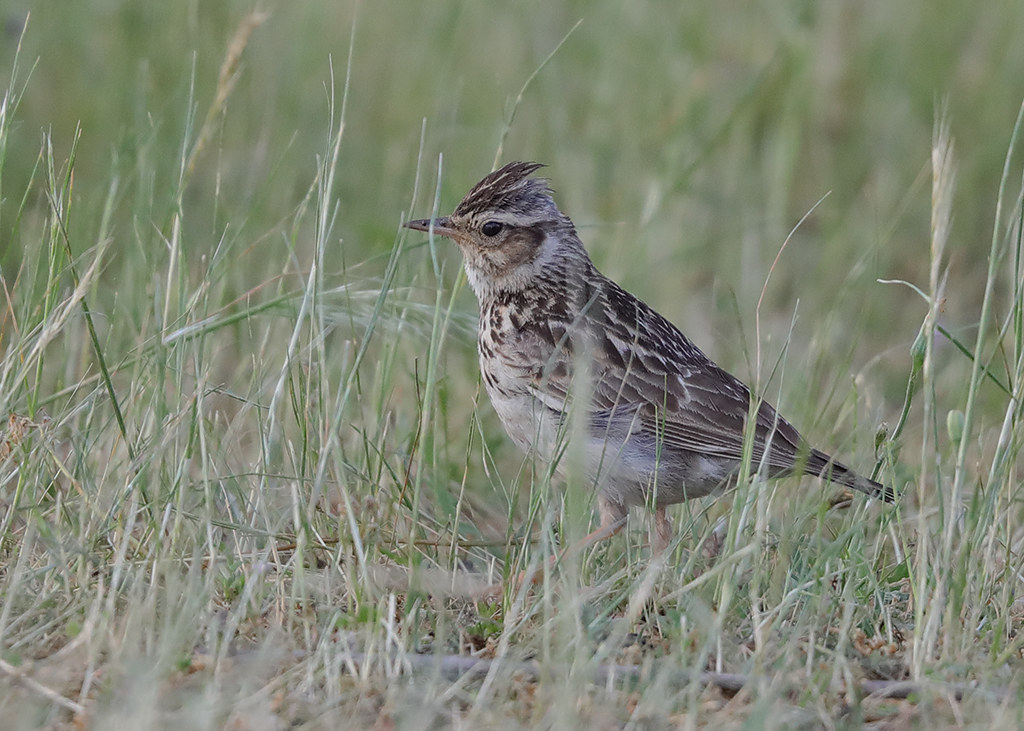
Woodlarks.
 They were a bit distant so I decided to chance my arm with my 2x converter to give me that extra reach in getting a closer shot.
 It's widely regarded that the 2x degrades the image quality, the end result being softer than it might be with a bare lens or even a 1.4TC but these shots looked good enough for my needs.
I was happy with that. The birds flew off so we moved on. Maybe things might get better from now?
Sadly they didn't. We found a bird hide overlooking a lake but everything was once again distant. We headed back to see if we could find the Woodlarks again, a desirable subject for us both.
We found them briefly but only briefly.
Still, a couple of more images captured, again using the 2.0x TC.
 They immediately walked away from the car when we stopped.
 It was rewarding but not rewarding enough. It was already lunch time and we felt we were not progressing too well.
A management decision was called for and we took it. We headed back to the motorway and off we went, north to Trujillo.
We checked out a place where Mike knew we'd find the Lesser Kestrels flying in and out of their nesting site.
The roof of the bullring.
It was an hours drive but at least we would get to photograph something, and photograph them we did!
At last we could let rip and took loads of shots in our attempts to catch the action.
 Not only did we have Kestrels but occasionally a Black kite would fly over closely too.
 A bare lens is easily best for birds in flight, the auto focus locks on so much quicker but you need the subject to be close. Here they weren't always so I'm all for experimenting if the time and opportunity presents itself using different lens and converter combinations and trying new camera settings. Mike raises an eyebrow on occasions when I tell him what I'm doing preferring to stick with his tried and tested methods and who am I to dispute the results? He seemed happy with his whilst I was seeing lots of rubbish in amongst some of mine. That was down to me.
After filling our boots and satisfying that need to fill a camera card we decided to check out another of Mike's recommendations.
The Birding Road.
You leave the centre of Trujillo then west along the N521 ignoring the first turn right until you get to the CC99 , a right turn towards Santa Marta de Gasca. It took us about 30 minutes but we realised we could have also taken the new motorway standard A5 road that runs parallel to the N521. Neither road had any traffic and appeared to be a waste of money. An E.U. grant perhaps?
Anyway what we saw next wasn't a waste in our opinion!
Every telegraph pole along the C99 had a nesting box on it and most were occupied.
 I think Rollers might be the intended target occupants but Jackdaws were also competing and surprisingly so were several pairs of Little Owls. Marvellous stuff!
 The latter box seems to catch the attention of every passing birder and there were quite a few. It was on the corner of the first left turn, an unmade road through the grasslands.
This was "the birding road".
Sure enough we soon had singing Calandra Larks
 and a plentiful number of Corn Buntings.
 but what we really wanted to see where Montagu's Harrier which we knew were in the area. Keeping in touch with Rich via the internet, he and Steve had got lucky along this stretch a couple of days before.
It wasn't to be today but at least the birds we did photograph were close!
 It was time to head home as we had an agreed dinner time of 7.30pm. We could just about make it in time for a quick shower first too.
There had been enough to satisfy us both fthat maybe we had turned a corner and things were on the up.Once again we were upbeat as we returned to Finca Flores for another excellent dinner sat out on the balcony although the sun had by now been enveloped in cloud.
TBC
For our first day Mike and I had decided that Arrocampo Reservoir would be our destination as it was en route to our next stopping place and roughly half way there too. Perfectly placed in fact!
I was up early, well not that early compared to days to come, and downstairs in the bar area by 7.00am. The hotel doesn't serve breakfast as such but they are open for coffee. Surprisingly busy too for that time of day. Locals wander in for coffee, to use the cigarette machine and even to play the fruit machines!
I was more interested in the assembling masses of photographers.
We hadn't been able to hire the hides for another 7 days because there was an organised group using them this week. I was keen to pump them for more information but as this was their first day they hadn't too much to give away. Their tour guide introduced himself and I gathered from conversations some of the restrictions that were the norm it seemed with this particular hide operator.
Interesting stuff!
We would be away for 4 nights but by the time we returned they should have some tips to give us before we started our hide days in 7 days time.
Meanwhile, off we went, heading once more down the main road, the E-90, towards Extremadura. The road continued as we had found it. Superbly maintained and virtually traffic free compared to the UK's motorway system.
Finding where we needed to be was fairly simple and we were the second car to arrive at that particular spot. There are several hides around the lake but the ones we checked out we didn't attempt to enter as they were all but useless for photography, instead we initially placed ourselves on the bank overlooking a reed lined inlet.
Birds were fairly plentiful and a good variety too but photography wasn't the easiest as there was a fair distance between us and our subjects.
The one bird that did come in close was the elusive Cetti's Warbler, one I have only seen on one previous occasion and that too was very, very brief.
 I managed an image of sorts but this was as good as it got.
On the other side of the inlet we had views of Purple Swamphen,
 and Purple Heron, both a European first for me.
We saw several Little Bitterns flying but you had to be quick to catch them.
 I was using my Canon 1DX2 and 500mm lens with a 1.4x teleconverter attached to try and get me that little bit closer. The teleconverter slows things down for auto focus so flight shots are a bit trickier but all my images were disappointing, not quite sharp. Still I wasn't too bothered as they were subjects I'd seen and photographed previously.
By now we had been joined by a tour group of birdwatchers that must have numbered at least 20. Shouting sightings across at each other and generally making a noise who say's that photographers are the nuisance factor?
Anyway, we were thankful when they moved off and we too decided to investigate another part of the reserve. Viewing there was no better, a Stonechat caught my attention for a few minutes
 as did a Zitting Cisticola, also known as the Fan-tailed Warbler.
 We decided enough was enough and headed south towards our new accomodation taking a slower back road rather than continuing on the motorway as we couldn't check in until 3.00pm and in fact I had told them it would be after 5.00pm.
As we drove along a part rough track road we noticed a large number of Shrikes, Larks and Corn Buntings. Very promising indeed! Further down the road we came across a large lake with distant views of Spotted Redshank, Greenshank, Egyptian Goose and Ringed Ploverbut the distance was too great for a decent photograph. The weather was blisteringly hot and I put down the reason for all my images being soft was the heat haze that causes image distortion.
 Moving on we called in to a local bar in Almoharin for a rehydrating Coke and a snack before checking in at Finca Flores.
Finca Flores is surrounded by olive groves and farmland, hopefully we would find some good subject matter around and about. Sadly this was not the case really.
A distant Woodchat Shrike
 and a struggle to lock on focus on to an overhead Booted Eagle summed up my day really.
 However, I wasn't alone. Mike too felt we hadn't really achieved too much on our first day and was just as frustrated.
The saving grace was our accommodation which although was a little pricey was also excellent.
A three course dinner at 20 euros pp included a bottle of excellent wine and having had a couple of beers beforehand we sat on the balcony and watched the sun go down whilst enjoying the feast and feeling nicely mellow yet upbeat about the prospects for the following day.
We also wondered what gourmet delights Steve and Rich might not be enjoying back in Colera Y Chozas!
TBC
No sooner than I had got home from my last trip and it was almost time to head off again, this time though it was a photo specific trip on what has become an annual jaunt with my good friend and near neighbour, Mike. We are very lucky to have understanding and generous wives who let us loose on our own but they are safe in the knowledge that we won't stray and we are literally totally focussed on our passion, wildlife photography.
In previous years we have travelled together to Scotland,Hungary, Bulgaria( twice) and Iceland. This year we decided to head west to Spain and specifically for the region of Extremadura, west of the capital city, Madrid. Mike had been some years ago so he had some prior knowledge but for me inland Spain was an unknown quantity and in fact it was many years since I last visited mainland Spain at all, probably about 40!
Extremadura is well known as a birding hotspot with several species we definitely had hopes of seeing and capturing in camera and it also has the benefit of being easy to access too and not particularly expensive. Last year our trip was the shortest for some time at 7 days, this year we decided to make it 14 which was stretching the goodwill of our ladies to the extreme but they gave their approval to go ahead , so go ahead we did.
Flights directly to Madrid with Easyjet is the perfect travel solution as they have an extremely generous hand luggage allowance and depart from nearby Liverpool. The cost was only £109pp return including one hold and one large size hand baggage. Car hire was £275 for 14 days although there was an additional charge of £70 for a named extra driver which we took up. Accommodation was booked using https://www.booking.com and we decided on a two centre trip, 4 nights near the town of Almoharin, south of Trujillo, 10 nights in Colera Y Chozas which is actually not in Extremadura but the neighbouring province of Castille La Mancha.
Why Colera Y Choza?
Because there is an opportunity to hire professionally run bird hides form a local operator and we wanted a mix of both hides and walkabout photography.
Our accommodation in Almorharin was the excellent Finca Flores Amarillas, in Colera Y Chozas the very inexpensive Hostal restaurant Cuatro Caminos. 14 nights accomodation would add up to £425 pp and nearly half being for the four nights in Finca Flores In total we were spending around £800 each plus shared petrol costs, food, drink and the hire of the hides.
All set, we left Liverpool on 23rd of April arriving in Madrid in the early evening. What should normally be a quick hire car pick up turned in to a drawn out affair as the girl on the desk was learning. We were eventually given our keys and a copy of the report of car were getting. It had 25 recorded damage spots! Ah well, less likely to notice anymore so we didn't mind that however when we opened the doors the stink of stale tobacco smoke was overwhelming so we refused to take it. Instead we were given a virtually brand new but underwhelming Citroen Elysee. Still, it served it's purpose and got us safely through the trip, in fact despite our long delay in picking the car up we arrived at our destination ahead of schedule thanks to Spain's excellent road network.
We had arranged the first night at Colera Y Chozas with good reason. Firstly it was an ideal stop over to break the journey further south, secondly it gave an opportunity to meet the hide operator to discuss what hides would be available to us but most importantly it gave us the chance to meet up with friends Steve and Rich who had arrived there several days previously and had already had their hide experiences.
They joined us for dinner mid way through our meal and Steve looked eagerly at our chicken stew which included some vegetables in it. He'd been asking for chicken all week but as yet hadn't been served any nor had they seen sight of anything remotely vegetarian. Tonight wasn't his lucky night either, they were served slices of pork and gravy with nothing to accompany it.
Food it seemed wasn't a strong point of the Hostal Cuatro Caminos, no choice either, you got what you were given.
To a certain extent the hide operator seemed to work in a similar fashion too but that we would discover later.
For now we had a pleasant evening discussing the hide experience , the gear needed in terms of lenses and a general catch up.
The weather Steve and Rich had experienced so far had been cold and windy, not typically springtime in Spain.
Would it improve?
We'd find out in the coming days.
T.B.C.
